

Lifestyle
Best VPN for online poker in 2026: 4 secure picks

Choosing the best VPN for online poker is mostly about two things players feel at the table: a connection that does not drop mid-hand, and security on whatever network you are playing from. A dropped connection during a tournament can fold your hand or cost you a stack, and public WiFi at a hotel is a poor place to log into an account with money in it. This guide ranks four secure, stable providers, with an honest note on legality first, because the rules here are not the same everywhere.
Quick verdict
The four VPNs best suited to online poker in 2026 are NordVPN, ExpressVPN, Surfshark, and Proton VPN.
NordVPN is the top pick for its connection stability and reliable kill switch, which together keep you from leaking or dropping at the worst moment. ExpressVPN is the choice for the lowest latency and steady speeds. Surfshark covers every device you own on one plan, and Proton VPN brings the strongest privacy posture for players who want it. All four are audited no-logs providers, which matters when an account holds real money.
A note on legality before anything else
Online gambling laws vary widely by country and by US state, and using a VPN to play on a site that is not licensed where you are can break both the site’s terms of service and local law. This guide is about security and connection stability for play that is already legal for you. It is not advice to bypass geographic restrictions or gamble where it is prohibited. Sportsbook and casino users face related location and account rules; our best VPN for sports betting guide explains those differences without treating a VPN as a bypass tool. Check your local rules, play only on licensed sites, and gamble responsibly, with support available from the National Council on Problem Gambling.
With that settled, the rest of this guide treats a VPN as what it is for a poker player: a way to protect your connection and your account, not a tool to get around the law.
Why poker players use a VPN
The reasons are practical rather than dramatic. Security comes first, because logging into a funded account over hotel or cafe WiFi exposes you on a shared network, and a VPN encrypts that connection. Stability comes a close second. Poker is unforgiving about disconnects, and a VPN with a solid network and a kill switch reduces the chance of dropping at a critical point, or of leaking your real connection if the tunnel blips. Players who travel also use a VPN to keep accessing their usual account and support tools from the road. None of that requires defeating a geo-block, and the picks below are chosen for stability and security, not for circumvention.
What to look for in the best VPN for online poker

Four qualities separate a VPN that suits poker from one that gets in the way.
Rock-solid connection stability
A drop mid-hand can cost real money. Look for a provider with a large, well-maintained network and a reputation for staying connected, so you are not reconnecting between hands.
A reliable kill switch
If the tunnel drops, a kill switch blocks traffic until it is back, so your real connection never briefly exposes the session. For poker that is about both privacy and not being flagged for an abrupt connection change.
Low, steady latency
Lag does not just annoy, it can cost you time-bank decisions. A fast protocol and a nearby server keep latency low and steady, which our best VPN for gamers guide digs into for the same reason.
Strong, audited security
An account with money in it deserves a provider whose no-logs claim is independently audited and whose encryption is current. All four picks below clear that bar.
The 4 best VPNs for online poker
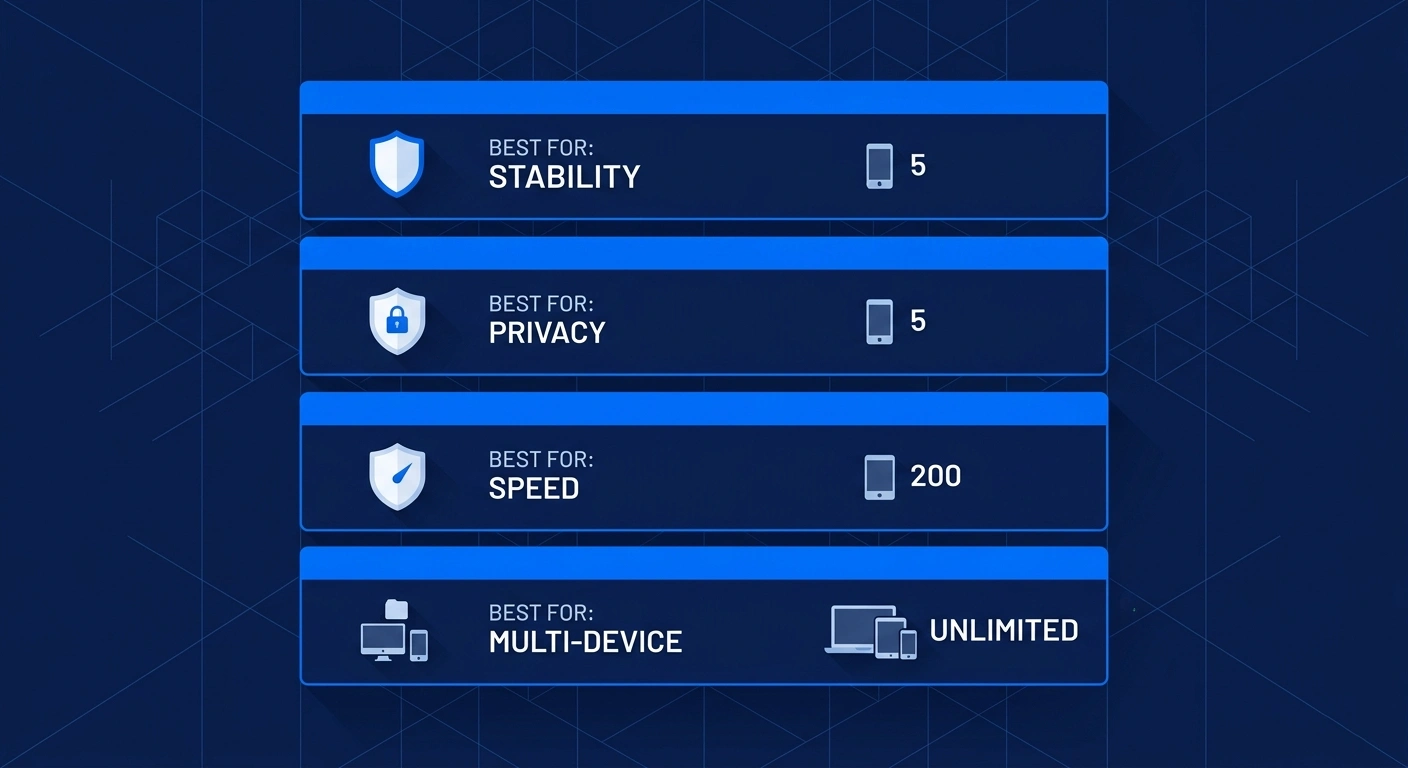
Here is how the four compare on what matters at the table, followed by the case for each.
| VPN | Best for | Devices | Approx price |
|---|---|---|---|
| NordVPN | Stability and kill switch | 10 | $3 to $4 / mo (2yr) |
| ExpressVPN | Lowest latency | 8 | $6.67 / mo (1yr) |
| Surfshark | Covering every device | Unlimited | $2 to $3 / mo (2yr) |
| Proton VPN | Privacy-first players | 10 | Free or paid tiers |
1. NordVPN. Best overall for stability
NordVPN is the safest default for poker. Its large network holds connections well, the NordLynx protocol keeps latency low, and the kill switch is dependable, so a blip does not turn into an exposed session. The no-logs policy is audited by PwC and Deloitte, which is reassurance worth having on a funded account. For the full assessment, see our NordVPN review.
2. ExpressVPN. Best for low latency
ExpressVPN runs its Lightway protocol, which is built for fast, stable connections, and its servers hold steady under load. If your priority is the lowest, most consistent latency for fast-paced tables, this is the pick. It carries KPMG and Cure53 reviews and runs on RAM-only servers. It costs more, at around 6.67 dollars a month on the annual plan.
3. Surfshark. Best for covering every device
Surfshark covers an unlimited number of devices on one plan, so your laptop, phone, and tablet are all protected without extra cost. Its no-logs policy is Deloitte-audited, and the two-year price is the lowest here. For players who switch between devices, it is the value choice.
4. Proton VPN. Best for privacy-first players
Proton VPN brings the strongest privacy posture, with Swiss jurisdiction, open-source apps, and annual Securitum audits. Its Secure Core routing adds a second hop for players who want maximum privacy on their session. There is a usable free tier with no data cap, though the paid plan is better for stable play. Our Proton VPN review covers where it fits.
The dedicated IP question
Some poker sites watch for accounts that connect from shared VPN addresses, because those addresses are used by many people and can look like collusion or multi-accounting risk. A dedicated IP, an address only you use, avoids that pattern and behaves more like a normal home connection. If your site is sensitive about IP changes, a dedicated IP add-on is worth considering, and our guide to the best VPN with a dedicated IP explains how the option works and which providers offer it. For most casual play, a standard server is fine, but it is a setting worth knowing about.
FAQ
Final word
For poker, a VPN is about protecting your connection and your account, not gaming the system.
NordVPN is the pick for most players thanks to its stability, low latency, and reliable kill switch, with an audit record that suits an account holding money. ExpressVPN is the answer if latency is your single priority, and Surfshark covers every device for less. Whichever you choose, keep it legal: play only where you are allowed and on licensed sites, stay on a nearby server, and treat the VPN as the security layer it is. The same licensing rules and the same connection questions apply on the sportsbook side, covered in our VPN guide for sports betting.