

Lifestyle
Best VPN for digital nomads in 2026

Editorial illustration; device interfaces are illustrative, not provider screenshots
This guide ranks the best VPN for digital nomads in 2026 based on independent reviewer consensus, public benchmarks, and user reports. Three made the cut.
Price check, October 22, 2026. NordVPN Basic: $94.23 for 27 months ($3.49/month equivalent), then $139.08 per 12 months; Surfshark Starter: $67.23 for 27 months ($2.49/month equivalent), then $79.00 per 12 months. Introductory terms are paid upfront. These are public USD offers, before applicable taxes; regional and affiliate checkout prices may differ. Other providers mentioned in this article were not part of this price update.
Quick answer
The best VPN for digital nomads in 2026 is NordVPN, with reliable obfuscation that works in restricted countries, fast NordLynx speeds across Asia and Europe, and Meshnet for secure device-to-device routing. ExpressVPN is the more reliable pick if China or the UAE are on your route. Surfshark wins on unlimited devices for nomads with multiple gadgets.
Top 3 picks
What nomads actually need from a VPN
A VPN that works fine on your home fiber connection can fall apart completely on a shared hotel network or behind a restrictive firewall. Here is what actually matters when you are moving between countries:
Reliable obfuscation
China, Iran, the UAE, and a growing list of countries actively block standard VPN traffic. You need a VPN that disguises itself as regular HTTPS. Most consumer VPNs cannot, and you will not find out until you are already there, offline.
Kill switch surviving network switches
Nomads switch networks constantly: hotel Wi-Fi to mobile hotspot to co-working Ethernet. Every switch is a window where your real IP can leak. Engagement within milliseconds, no manual restart, non-negotiable.
Multi-device support
Laptop, phone, tablet, sometimes a travel router. You need a VPN that covers all of them on one subscription without charging per device.
Split tunneling
Running your local banking app through a VPN sometimes triggers fraud alerts. Split tunneling lets you route specific apps around the VPN while keeping everything else protected.
Consistent international speeds
A VPN that gives strong speed retention on US servers but drops sharply on Southeast Asian servers is useless half the year. Public benchmarks that test multiple regions, not just one home location, are the ones worth trusting.
Server diversity
Server count matters less than spread. A VPN with 50 countries and city-level selection beats one with 100 countries clustered in 5 regions for actual nomad use.
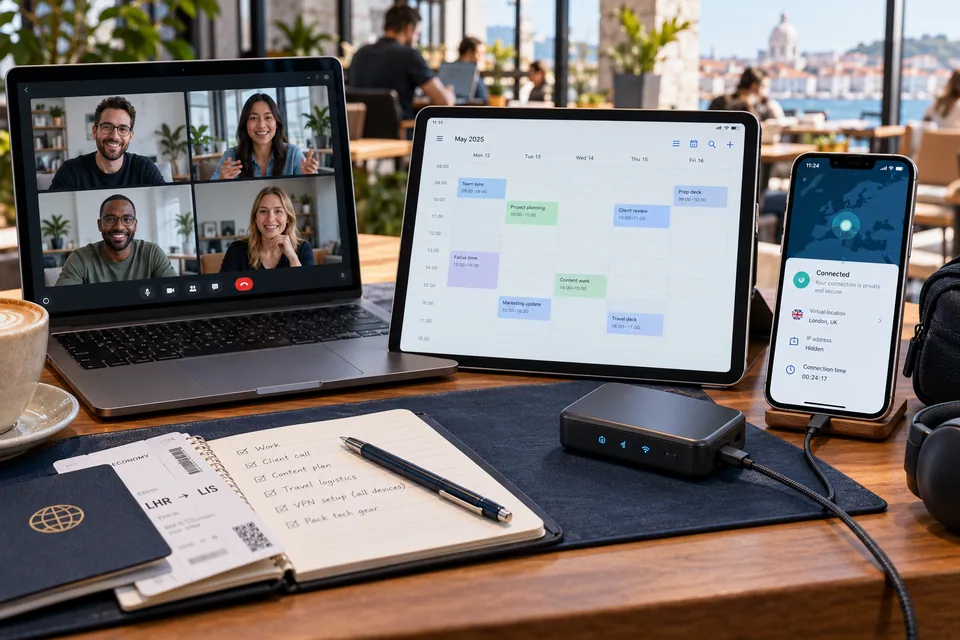
Editorial illustration; device interfaces are illustrative, not provider screenshots
1. NordVPN, best overall for digital nomads
NordVPN covers more ground than any other consumer VPN for nomad use. The server network is large enough that you are rarely more than a few hundred kilometers from a fast server, the obfuscation works in China with Obfuscated Servers enabled, and the client handles network switches without dropping the kill switch.
What stands out. The Meshnet feature lets you create a private encrypted network between your own devices, which is useful when you need secure access to a file on your laptop from your phone without routing through a third-party server. Reviewers consistently single it out as a differentiator.
What reviewers report. NordVPN is consistently rated among the fastest VPNs in public benchmarks, with NordLynx (its WireGuard-based protocol) holding speed well across US, European, and Asian servers. For restricted networks, reviewers report Obfuscated Servers connect reliably in China more often than most competitors, though no consumer VPN is guaranteed there. The kill switch is reported to engage reliably across network switches.
Pros
- Broad international server coverage
- Obfuscation options for restrictive networks; availability is not guaranteed
- Meshnet for device-to-device encrypted routing
- NordLynx (WireGuard-based), among the fastest per benchmarks
- Kill switch reliable across network changes
- 10 simultaneous connections
Cons
- Obfuscated Servers only available on specific server locations
- iOS client slightly less polished than desktop
- Renewal pricing higher than introductory rate
Pricing. $3.49/month equivalent on the 27-month introductory term. 30-day refund.
Verdict. For most digital nomads who move between countries including occasionally restricted ones, NordVPN is the pick that covers the widest range of scenarios without requiring you to think too hard about which server to connect to.
2. ExpressVPN, best for restricted countries
If your route regularly includes China, Iran, or the UAE, ExpressVPN is the more reliable choice for those specific destinations. Its Lightway protocol with obfuscation is consistently rated by reviewers as having one of the best connection records in China. The tradeoff is cost and the device limit of the selected plan.
What reviewers report. ExpressVPN’s Lightway protocol is rated fast and stable across regions in public benchmarks. For restricted networks, reviewers and user reports from communities like Reddit r/VPN consistently place ExpressVPN among the most dependable options for China and Iran. Its customer support is widely praised for fast, technically competent responses.
Pros
- Among the best-rated for obfuscation in China and Iran
- RAM-only servers (TrustedServer, nothing written to disk)
- Lightway protocol consistently fast
- Widely praised customer support
- Split tunneling on supported apps; availability varies by platform
- 30-day refund
Cons
- More expensive than NordVPN ($6.67/month vs $3.49)
- 10 to 14 simultaneous connections, depending on the plan
- No Meshnet-equivalent feature
Pricing. $6.67/month on the 12-month plan.
Verdict. If China or other heavily restricted networks are a regular part of your travel schedule, ExpressVPN is worth the premium. If you are mostly in Southeast Asia, Europe, and Latin America, NordVPN’s better pricing wins.
3. Surfshark, best for multi-device nomads
Surfshark‘s selling point for nomads is simple: unlimited simultaneous connections on one subscription. If you run a laptop, a phone, a tablet, and occasionally a smart TV in your accommodation, no other VPN in this price range covers all of them without counting.
What reviewers report. Surfshark is rated slightly behind NordVPN and ExpressVPN on raw speed in public benchmarks, but still solid for video calls and streaming. Camouflage mode (its obfuscation) is reported to work in the UAE but is less consistent in China, so reviewers recommend NordVPN or ExpressVPN if China is a priority. CleanWeb (built-in ad blocker) is a genuine quality-of-life improvement when you are constantly connecting to unfamiliar networks.
Editorial illustration; device interfaces are illustrative, not provider screenshots
Pros
- Unlimited simultaneous connections
- Cheapest of the three ($2.49/month equivalent on the 27-month introductory term)
- CleanWeb ad/tracker blocker included
- Camouflage mode for obfuscation
- No-logs policy audited by Deloitte
Cons
- Slower than NordVPN and ExpressVPN on average
- Inconsistent performance in China
- Renewal price jumps after introductory period, read the terms
Pricing. $2.49/month equivalent on the 27-month introductory term. Check the renewal terms before committing, the introductory rate applies to the first billing cycle.
Verdict. Surfshark is the right pick if unlimited devices matter and you are not regularly working in China. For most Southeast Asia and Europe routes, the speed difference versus NordVPN is acceptable at half the price.
Comparison table
| Feature | NordVPN | ExpressVPN | Surfshark |
|---|---|---|---|
| Best for | Overall nomad use | Restricted countries | Multi-device |
| Price (best plan) | $3.49/mo (27-month introductory term) | $6.67/mo (12mo) | $2.49/mo (27-month introductory term) |
| Simultaneous devices | 6 | 8 | Unlimited |
| Protocol | NordLynx (WireGuard) | Lightway | WireGuard |
| Speed (public benchmarks) | Among the fastest | Among the fastest | Fast |
| China reliability | Good | Best rated | Inconsistent |
| Kill switch | Reliable | Reliable | Reliable |
| Split tunneling | Yes | Yes (per app) | Yes |
| Audit | Deloitte (2023) | KPMG | Deloitte |
| Refund | 30 days | 30 days | 30 days |
How to choose the best VPN for digital nomads
China / Iran
You travel to China or Iran regularly: ExpressVPN. The reliability gap in restricted environments is real and it costs you when you are on a deadline.
3+ devices
You need one subscription for 3+ devices: Surfshark, no contest. Unlimited connections.
Best balance
You want the best balance of speed, features, and price: NordVPN for most nomads.
Client data
You work with sensitive client data: NordVPN’s Meshnet or NordLayer (their business product) gives you private encrypted routing between devices without relying on a shared VPN server. See our small business VPN comparison.
If speed drops are affecting your video calls, the issue is usually the server location or protocol, not the VPN itself. See our VPN speed troubleshooting guide, it covers the fixes that actually work.
Torn between the top two picks? Our NordVPN vs ExpressVPN comparison breaks down the audit, speed, jurisdiction, and price differences in full.
If you move funds between exchanges while traveling, our guide to the best VPN for crypto traders covers the no-logs and kill-switch features that matter for Binance, Coinbase, and Kraken.
Travelers working from mobile hotspots and campground Wi-Fi should also compare the best VPNs for RV and van life, where connection changes and limited bandwidth matter more than hotel Wi-Fi.
Sources
Recommendations in this article are based on:
- Independent reviewer consensus (Tom’s Guide, TechRadar, PCMag, Cybernews)
- User feedback from Reddit r/VPN and Trustpilot
- Official provider documentation (verified May 2026)
FAQ
Our verdict
NordVPN is the default pick for digital nomads.
It covers the most ground, speed, server count, obfuscation, device limit, Meshnet, at a price that makes sense for long-term use. ExpressVPN earns its premium only if you work in China or other heavily restricted environments regularly. Surfshark wins on the unlimited devices case and nothing else. Do not overthink the protocol settings. Install the app, switch to NordLynx or Lightway, pick a server close to where you are working, and move on. The VPN should run in the background, not occupy your afternoon. For a broader look at how to pick a VPN from scratch, our plain-English VPN guide covers the fundamentals without the marketing noise. If you also download large files on the road, our best VPN for torrenting guide covers the safest picks.