

Lifestyle
Best VPN for RV and van life in 2026: 4 picks for the road
Choosing the best VPN for RV and van life is not the same as picking one for a fixed home connection. On the road you jump between cellular hotspots, Starlink, and whatever WiFi the campground hands out, and your VPN has to hold up across all three. This guide ranks four providers on the things that matter when your office moves every few days, drawn from independent audits and aggregated user reports rather than a staged road trip. If you work full time on the move, read it alongside our best VPN for digital nomads pillar.
Quick verdict
The four VPNs worth installing in a rig in 2026 are NordVPN, Surfshark, ExpressVPN, and Proton VPN.
NordVPN is the overall pick: its NordLynx protocol stays fast over weak cellular, the kill switch holds when you roll through a dead zone, and it carries independent no-logs audits. Surfshark wins if your rig is full of gadgets, because one subscription covers an unlimited number of devices. ExpressVPN is the best choice for putting a home stream on a travel TV. Proton VPN has the only free tier worth using for short, occasional trips.
How we evaluated VPNs for life on the road
A VPN that scores well at a desk can fall apart in a moving van. The ranking below weighs the factors that change once your connection is mobile: whether the apps reconnect cleanly over cellular and Starlink, whether the kill switch actually fires when the signal drops, how many devices a single plan covers, and how reliably the provider reaches the home-country servers you need for streaming. Encryption on shared campground WiFi is treated as a baseline requirement, not a bonus. The provider claims were checked against published independent audits and user reports aggregated from Trustpilot and the overlanding communities on Reddit. None of this involved a sponsored trip, and no provider paid for placement.
What actually matters in an RV or van
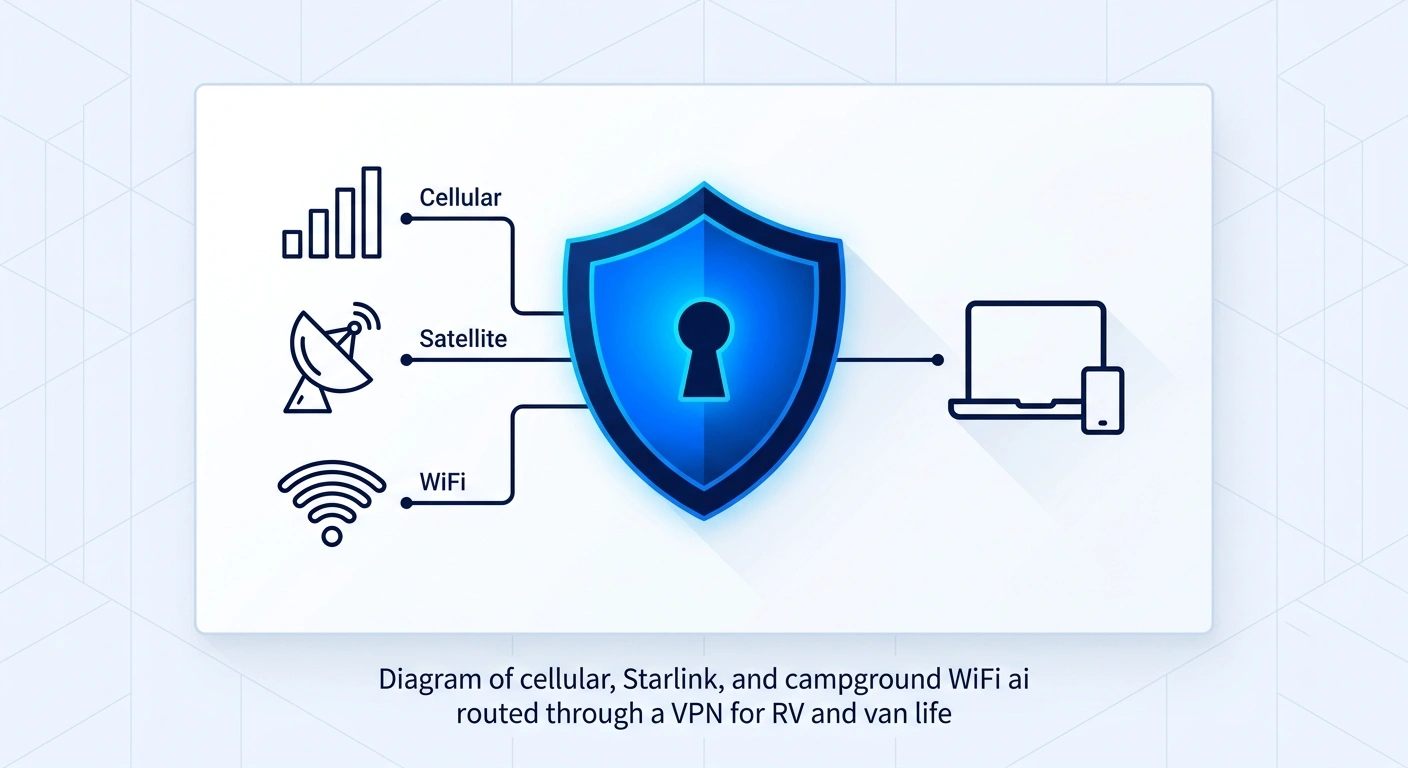
Four things separate a VPN that survives van life from one that becomes a daily annoyance. Get these right and the app stays invisible.
Connection stability over cellular and Starlink
Cellular and satellite links have higher latency and more packet loss than home fiber. A protocol built for that environment matters. WireGuard-based options such as NordLynx reconnect faster after a handoff between towers and recover better when Starlink re-points, which is why they dominate this list.
A kill switch that survives dead zones
You will lose signal. The question is what your laptop does in that moment. A kill switch blocks all traffic until the tunnel is back, so a banking session or a work login does not briefly leak onto an open connection while the VPN reconnects. Confirm it is enabled before you leave the driveway.
Enough device slots for a mobile setup
A typical rig runs a phone, a laptop, a tablet, a streaming stick, and often a partner’s devices on the same plan. Providers cap simultaneous connections at different numbers, so the device count is a real buying factor here in a way it never is at home.
Encryption on campground and RV-park WiFi
Park and campground WiFi is shared, rarely encrypted, and a soft target for anyone parked nearby, the public-WiFi exposure the FTC warns travelers about. A VPN encrypts everything leaving your device, so a neighbor sniffing the access point sees nothing usable. This is the one feature every traveler in this guide genuinely needs. Anyone running a company from the road carries the same exposure with client data, which our small business VPN comparison covers in more detail.
The best VPN for RV and van life: our 4 picks
Here is how the four providers compare on the metrics that matter for a mobile setup, followed by the case for each.
| VPN | Devices | Best for the road | Approx price |
|---|---|---|---|
| NordVPN | 10 | Overall speed and security | $3 to $4 / mo (2yr) |
| Surfshark | Unlimited | Gear-heavy rigs | $2 to $3 / mo (2yr) |
| ExpressVPN | 8 | Streaming on travel TVs | $6.67 / mo (1yr) |
| Proton VPN | Varies by plan | Free light use | Free or paid tiers |
1. NordVPN. Best overall for the road
NordVPN is the one to install if you only install one. The NordLynx protocol holds its speed over weak cellular better than standard OpenVPN, the kill switch reliably blocks traffic through a dead zone, and Threat Protection filters malware and trackers on the kind of open WiFi you find at parks. It covers 10 devices, and the no-logs claim has been audited more than once by PwC and Deloitte. Pricing lands at around 3 to 4 dollars a month on the two-year plan. For the full breakdown of speeds, audits, and what users report, see our NordVPN review.
2. Surfshark. Best for a gear-heavy rig
Surfshark exists for the rig that looks like a small electronics store. One subscription covers an unlimited number of simultaneous connections, so a phone, a laptop, a tablet, a Fire TV, and a partner’s devices all run on a single account with no per-seat math. Its no-logs policy was audited by Deloitte, and the two-year price is among the lowest here. If your problem is device count rather than raw speed, this is the value pick.
3. ExpressVPN. Best for streaming on travel TVs
ExpressVPN earns its spot through MediaStreamer, a smart-DNS feature that puts a home-country stream on a Fire TV or smart TV that has no native VPN app. That solves a real van-life headache, because a lot of travel TVs cannot run a VPN client directly. Its servers run on TrustedServer, a RAM-only design wiped on every reboot, and the apps and infrastructure have been reviewed by KPMG and Cure53. It covers 8 devices and sits at around 6.67 dollars a month on the annual plan.
4. Proton VPN. Best free tier for light, occasional trips
If you only need a VPN for the odd weekend away, Proton VPN has the only free tier worth recommending. It carries no data cap, runs from Swiss jurisdiction, and ships fully open-source apps that Securitum audits each year. The free servers are limited and not built for streaming, so a heavy traveler will outgrow them, but for occasional use it covers the public-WiFi safety case at no cost. Our Proton VPN review covers where the paid tier becomes worth it.
Watching your home streaming services from the road
Travel breaks streaming in two ways. Cross a border and your home catalog disappears, because the service swaps to the local library or blocks you outright. Even inside your own country, some live sports feeds are tied to a billing region. Connecting to a server back home restores the catalog you already pay for. The trade-off is that streaming platforms actively detect VPN traffic, so the provider has to keep its addresses fresh, which is exactly where the audited picks above pull ahead of cheaper options. For the full ranking by platform, see our best VPN for streaming guide.
Setting it up before you leave
Configure everything while you still have a stable connection in the driveway. Sorting it out later on a single bar of signal at a remote site is the wrong time to learn the settings. A short checklist before departure:
- Install the app on every device that will travel, including the streaming stick.
- Turn on the kill switch so a dropped signal cannot leak your traffic.
- Enable auto-connect on untrusted WiFi, so campground networks are covered without you remembering.
- Run a quick test over cellular, not just home WiFi, to confirm the tunnel holds.
- Keep offline maps and key documents downloaded as a backup for dead zones.
New to this? Our how to set up a VPN walkthrough covers the first install step by step.
FAQ
Final word
Life on the road asks more of a VPN than a home connection ever does: stable reconnects over cellular and satellite, a kill switch that fires in dead zones, enough device slots for a mobile setup, and reliable home-country servers for the shows you already pay for.
NordVPN delivers all four with the strongest audit record, which makes it the pick for most travelers. If your rig is heavy on gadgets, Surfshark covers the lot on one plan for less money. Sort it out before you pull away, and the VPN simply runs in the background for the rest of the trip. Once the travel stops being temporary, the priorities shift toward home banking and subscriptions, which our VPN guide for expats takes from there.
