

Cross-silo
Proton VPN vs Surfshark: which one should you choose in 2026?
Proton VPN vs Surfshark compared on audits, transparency, devices, network, features, pricing checks, and the buyer each service fits best.
Proton VPN vs Surfshark is a close comparison with a clear dividing line. Proton VPN is the better fit for buyers who value open-source apps, published annual no-logs audits, and a useful free plan. Surfshark is easier to recommend to a large household because one subscription allows unlimited simultaneous connections. After checking the providers' current documentation on October 1, 2026, our pick for this page is Proton VPN.
Quick verdict
Choose Proton VPN if privacy transparency is your first filter.
Its apps are open source, its 2026 no-logs report is publicly available, and the company says this is its fifth consecutive annual no-logs audit. The paid VPN Plus plan supports up to 10 simultaneous devices, while the free plan has no data cap and works on one device at a time. Choose Surfshark if the 10-device limit would get in your way. Surfshark allows unlimited simultaneous connections and lists 4,500+ servers in 100 countries. Its no-logs policy was independently assessed by Deloitte in 2023 and again in 2025. Our overall choice is Proton VPN, but only by the decision rule above. A household protecting more than 10 devices can reasonably reach the opposite conclusion.
VPNVertex may earn a commission if you subscribe through our Proton VPN link. This does not change the comparison criteria or findings.
How we evaluated and verified them
This is a documentary comparison, not a VPNVertex hands-on test. We reviewed and cross-checked both providers' current plan, network, device-limit, protocol, privacy, audit, and refund materials. For privacy claims, we compared each provider's own policy with the scope and public availability of the cited independent audit evidence; for features, we noted when support varies by app or plan. We did not connect to either VPN, generate original throughput measurements, test streaming libraries, or inspect reports restricted to account holders.
We compared like with like where the published evidence allowed it, separated provider statements from independent findings, and retained caveats when pricing or features depend on plan, location, currency, platform, or promotion. That makes this a source-checked buying comparison, not a direct product trial. Read our research methodology for the sourcing rules behind this article.
Proton VPN vs Surfshark at a glance
| Decision point | Proton VPN | Surfshark |
|---|---|---|
| Best fit | Transparency and privacy controls | Large households and many devices |
| Simultaneous connections | Up to 10 on VPN Plus | Unlimited on a paid subscription |
| Published network | 20,000+ servers in 140+ countries | 4,500+ servers in 100 countries |
| Free plan | Yes, unlimited data on one device | No permanent free plan |
| Latest no-logs evidence checked | Securitum, 2026; public report | Deloitte, 2025; report available to users |
| Multi-hop option | Secure Core | Dynamic MultiHop |
| Introductory and renewal price | Verify the checkout total | Verify the checkout total |
Provider figures and policies checked October 1, 2026. Network totals can change as locations are added or removed.
Privacy and transparency: Proton VPN has the stronger case
What Proton VPN publishes
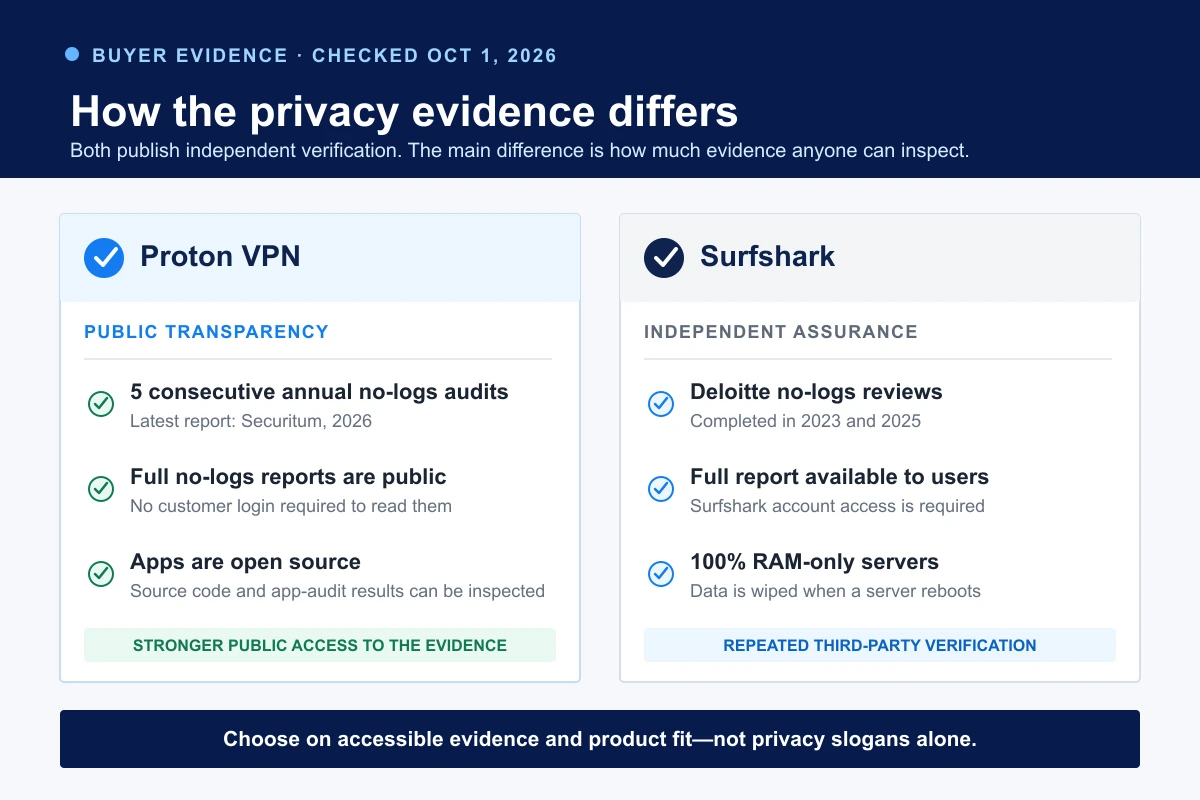
Proton VPN operates under Swiss law and publishes the source code for its apps. Its current no-logs page links to annual Securitum reports from 2022 through 2026. The 2026 report is the fifth consecutive annual review and covers whether the examined server infrastructure records browsing activity, DNS queries, destination services, traffic content, or connection metadata that identifies users.
Open source does not guarantee that software is free of defects, and an assurance report is a point-in-time assessment. Together, however, public code and a public recurring audit give buyers more evidence to inspect than a policy statement alone. Our full Proton VPN review explains the rest of its privacy controls.
Original editorial image created for VPNVertex.
What Surfshark publishes
Surfshark is based in the Netherlands and says its VPN infrastructure is RAM-only. Deloitte assessed its no-logs controls in 2023 and 2025. Its Trust Center also lists a 2025 infrastructure review by SecuRing and a 2026 Cure53 assessment of infrastructure and the Dausos protocol. The detailed Deloitte no-logs report is available through a Surfshark account rather than as a fully public report.
That is credible evidence, not a privacy red flag. Proton VPN wins this category because more of its relevant evidence is open for anyone to inspect. Jurisdiction is one factor, but the provider's technical design, data handling, and independent verification matter more than a country label by itself.
Devices and everyday use: Surfshark removes the cap
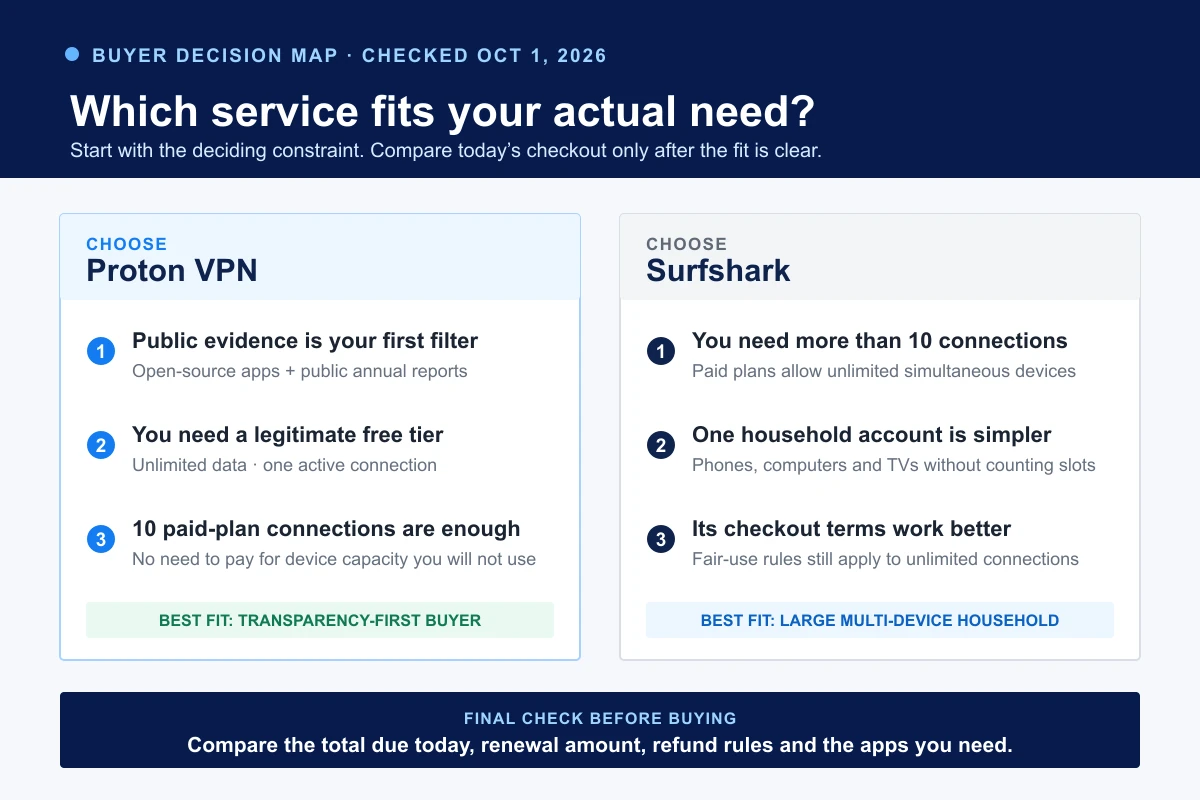
Proton VPN Plus supports up to 10 simultaneous device connections. That is enough for many individuals and small households. Surfshark allows unlimited simultaneous connections, which is simpler when a family uses several phones, computers, tablets, televisions, and streaming devices.
The word unlimited still comes with normal service terms. It does not mean account sharing outside the provider's permitted use. For an ordinary household, though, Surfshark's policy removes the need to count active devices.
Proton VPN's free plan is the more useful starting point for one person. It offers unlimited data, one connection at a time, and access to servers selected from 10 countries. That plan is intended for basic privacy; Proton reserves premium features, broader location choice, P2P, and secure streaming support for paid tiers.
Speed and streaming: no universal winner
Both providers support modern VPN protocols and operate large networks. Proton VPN lists WireGuard, OpenVPN, IKEv2, and its Stealth protocol across supported apps. Surfshark lists WireGuard, OpenVPN, and IKEv2, with availability varying by platform.
We are not declaring a numerical speed winner because VPN performance changes with the test device, base connection, protocol, server distance, and local congestion. A result from another lab is useful context, but it is not a promise about your home connection.
Streaming access also changes when platforms update their detection systems. Treat provider compatibility lists as current guidance, not a permanent guarantee. If a specific service matters, test it during the applicable refund window and read the platform's terms. Our Surfshark review covers its broader feature set without turning a single benchmark into a universal claim.
Original editorial image created for VPNVertex.
Price and renewal terms
Do not compare only the advertised monthly equivalent. Long plans are usually charged upfront, taxes can be added, introductory terms can differ, and renewal pricing may be higher. Open both checkouts for the same subscription length and record four figures: the amount due today, the term length, the renewal amount, and any non-refundable add-ons.
Both providers advertise a 30-day money-back period for eligible initial purchases, subject to their current terms and purchase channel. Surfshark's terms exclude some add-ons and recurring payments. Proton VPN also directs buyers to its refund terms for eligibility. Verify those conditions before payment.
Surfshark can cost less per protected device in a large household because it has no simultaneous-connection cap. Proton VPN can cost nothing for a one-device basic privacy use case because its free plan has no data cap. Those are different value questions, so there is no honest permanent price winner.
Which one fits you?
Choose Proton VPN if
- You want public annual no-logs reports and open-source apps.
- You prefer Secure Core and Proton's privacy-focused product ecosystem.
- Ten simultaneous connections are enough.
- You want a legitimate free plan for one device with no data cap.
Choose Surfshark if
- You need more than 10 devices connected at the same time.
- You want one subscription that is easy to extend across a household.
- Dynamic MultiHop or Surfshark's wider security bundle matters to you.
- The current checkout total and renewal terms are better for your budget.
If Proton VPN remains your likely choice, compare it with our NordVPN vs Proton VPN analysis before buying. If unlimited connections decide the result, our NordVPN vs Surfshark comparison gives Surfshark a second head-to-head.
FAQ
Final verdict
Before committing to a long plan, check the total due today, renewal amount, refund eligibility, and the apps you need. For a provider-specific follow-up, read our Proton VPN review before checking the current plan.
Proton VPN is our pick in this comparison. Its open-source apps and publicly available sequence of annual no-logs reports make the recommendation easier to verify. Surfshark remains the more practical choice for a household that would exceed Proton VPN's 10-device limit.
Sources
External sources are listed as text rather than outbound links. Checked October 1, 2026.
- Proton VPN Support, "Proton VPN plans explained."
- Proton VPN, "For the fifth year running, Proton VPN passes an independent no-logs audit."
- Proton VPN, privacy policy and features documentation.
- Surfshark Trust Center, audit and infrastructure records.
- Surfshark, "Our no-logs policy was verified again," June 16, 2025.
- Surfshark support, device, plan, and refund documentation.