

Cross-silo
Best VPN services in 2026: 3 trusted options compared

Compare NordVPN, Surfshark and Proton VPN by privacy evidence, device limits, useful controls, upfront price and renewal terms.
NordVPN is our best all-around starting point, Surfshark is the strongest fit for a household that needs unlimited simultaneous connections, and Proton VPN is the clearest choice for open-source transparency or a legitimate free tier. None is automatically best for everyone. The right choice depends on the evidence you value, the number of devices you use, and the price you will actually pay.
This assessment is based on official documentation, published independent assurance reports and prices checked on October 1, 2026. It is not a VPNVertex hands-on speed, leak or streaming test.
Quick verdict
| Need | Starting point | Why it stands out | Main limitation |
|---|---|---|---|
| Best all-around balance | NordVPN | Broad feature set, 10 devices and a sixth independent no-logs assurance engagement | Higher verified long-term and renewal cost than the other paid offers checked |
| Many household devices | Surfshark | Unlimited simultaneous connections and the lowest verified paid entry price in this comparison | Unlimited use still falls under the provider's fair-use and anti-abuse rules |
| Transparency or no-cost entry | Proton VPN | Open-source apps, published audits and a free plan without ads or data limits | The free plan protects one device and gives less server choice than Plus |
These are starting points, not permanent awards. Features, plan terms and prices change. A trustworthy comparison should show why a provider fits a specific need and where that recommendation stops.
Best VPN services compared
The price figures below come from official US-dollar pages checked on October 1, 2026. The audit column describes a point-in-time independent assessment, not a guarantee that every future configuration will remain unchanged.
| VPN | Simultaneous devices | Published privacy evidence | Verified introductory payment | Verified renewal |
|---|---|---|---|---|
| NordVPN | 10 | Deloitte reasonable-assurance engagement completed in December 2025 | $94.23 for 27 months | $139.08 for 12 months |
| Surfshark | Unlimited | Deloitte ISAE 3000 no-logs assurance report dated June 2025 | $67.23 for 27 months | $79 for 12 months |
| Proton VPN Plus | 10 | Securitum's fifth annual no-logs audit published in 2026 | $71.76 for 24 months | $83.88 for 12 months |
Prices are not permanent and taxes can change the amount charged. For a fuller breakdown of term length, refunds and the difference between an advertised monthly equivalent and the amount due today, read our cheap VPN price comparison.
How we compared these VPNs
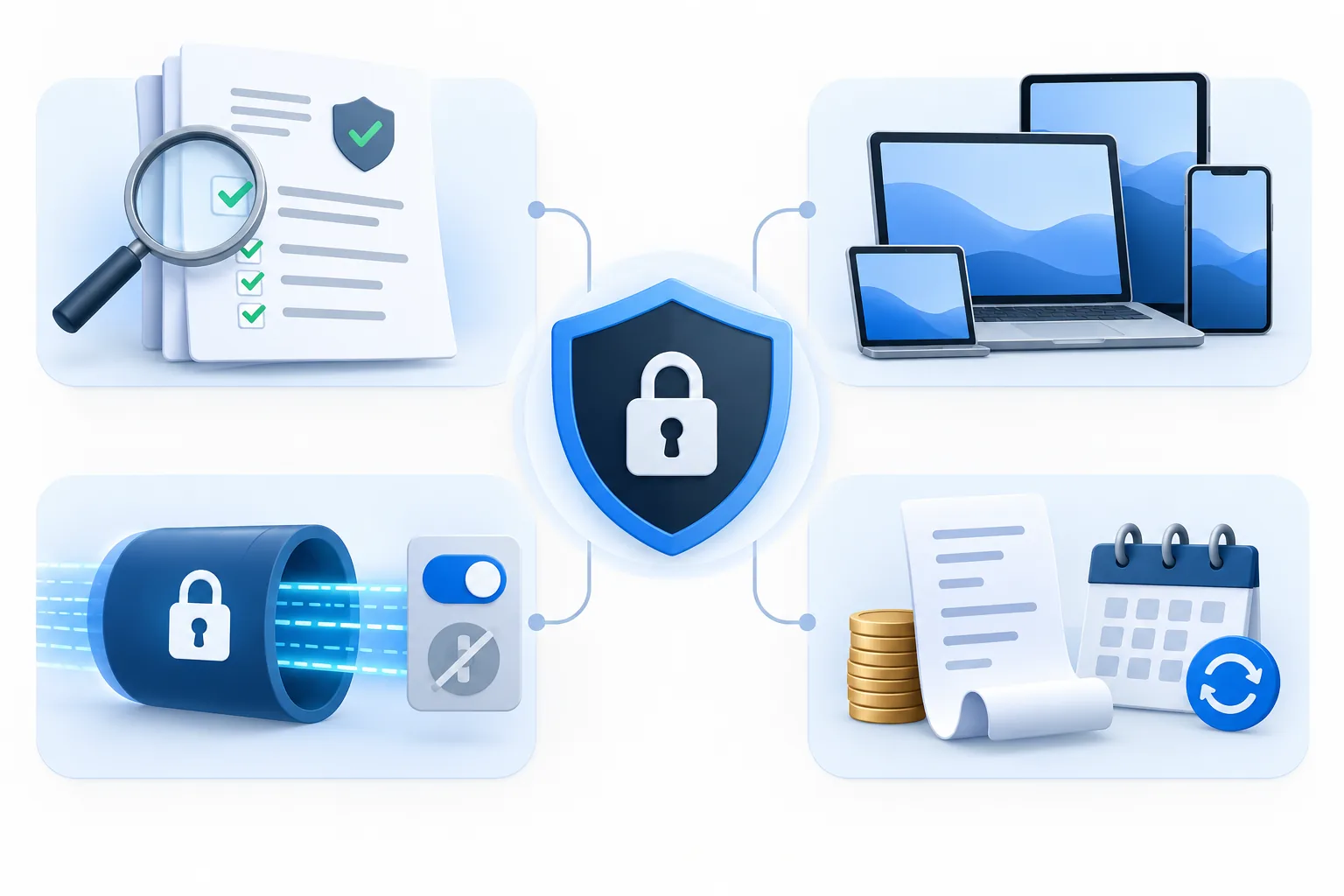
We limited the page to NordVPN, Surfshark and Proton VPN because they are the three commercial partners currently authorized for VPNVertex. Inclusion does not remove the need for evidence. We checked official device limits, protocol and safety documentation, public audit material, and the dated US price records used in our price guide.
We gave more weight to evidence a reader can identify than to an unsupported superlative. A no-logs statement is stronger when an independent firm examines the relevant infrastructure and explains the scope. Open-source software improves inspectability, but it does not prove that every user can personally review the code. A large server count is not a substitute for a clear privacy policy, a kill switch or suitable apps.
We did not purchase subscriptions for this page, run speed tests, test streaming access, inspect DNS or IPv6 leaks, exercise a kill switch, contact support or request refunds. After installation, verify the public IP, DNS and WebRTC behavior where relevant, and test the kill switch safely before relying on it.
NordVPN: best all-around starting point
NordVPN is our first place to look when you want a broad consumer VPN rather than the cheapest plan or the most permissive device policy. Its current support documentation lists 10 simultaneous device connections, an automatic kill switch, DNS leak protection, obfuscated servers, Double VPN, Onion Over VPN, and support for NordLynx, OpenVPN and IKEv2/IPsec.
The strongest trust signal in this comparison is repeat verification. Deloitte Lithuania completed NordVPN's sixth no-logs reasonable-assurance engagement in December 2025. The provider says the work covered standard VPN, Double VPN, obfuscated and Onion Over VPN server configurations. The public summary is available without a login, while the full technical report requires a Nord Account.
The trade-off is price. In the official US offer recorded for our October 1 comparison, NordVPN Basic cost $94.23 upfront for 27 months and listed a $139.08 annual renewal. That was higher than the equivalent Surfshark and Proton VPN offers checked on the same date. Our NordVPN review examines the provider-specific evidence in more detail.
Surfshark: best for unlimited devices and price
Surfshark is the simplest option for a household that does not want to count device slots. The provider states that Starter, One and One+ allow unlimited simultaneous connections. Its support page also makes clear that this is meant for legitimate household use and remains subject to anti-abuse controls.
Surfshark's published Deloitte ISAE 3000 report examined whether the VPN infrastructure was designed and implemented with a no-logs configuration as of June 10, 2025. That is meaningful evidence, but it remains a dated assurance engagement with a defined scope rather than a permanent security certificate.
Surfshark also led the paid price comparison checked on October 1. Starter was $67.23 upfront for 27 months, with a $79 annual renewal listed in the provider's terms. Unlimited devices can improve household value, but only if the apps and features fit the devices you actually own. Read our Surfshark review for the fuller product-level assessment.
Proton VPN: best for transparency and a free entry point
Proton VPN is the strongest transparency-led option here. Its apps are open source, it publishes third-party audit material, and Securitum completed the provider's fifth consecutive annual no-logs infrastructure audit in 2026. Proton's public summary says the review did not find logging of browsing activity, DNS queries, destination services, traffic contents or user-identifiable connection metadata in the examined infrastructure.
Proton VPN Plus allows up to 10 simultaneous devices. The free plan is different: it supports one device, has no ads and no data or time limit, but offers less server choice and fewer paid features. That makes it a credible no-cost starting point, not a feature-for-feature replacement for Plus.
The Plus offer checked for our price comparison was $71.76 upfront for 24 months and listed an $83.88 annual renewal. Buyers who value published audit access and open-source apps may prefer Proton even when another provider is cheaper. Our Proton VPN review covers the provider-specific trade-offs.
There is no single safest VPN
A VPN moves trust from the local network and internet provider to the VPN provider. It can encrypt traffic between your device and the VPN server and replace the IP address websites normally see. It cannot make a compromised device safe, stop every phishing attempt, hide activity after you sign in to an account, or make illegal activity lawful.
For a safer choice, look for a kill switch on the platforms you use, DNS and IPv6 leak protection, maintained apps, a clear logging policy, independent evidence with a date and scope, and a refund process you understand. Protocol names matter less than correct implementation, and no protocol name compensates for an app that is not maintained correctly.
Trust rule: treat every audit as evidence about a defined system at a defined time. Check who performed it, what was examined, when the work happened and whether the full report is available.
How to choose the right VPN service
Start with your devices
List the computers, phones, TVs and routers you will actually protect. Ten connections are enough for many people; unlimited connections simplify a larger household.
Check the full payment
Compare the amount due today, the number of included months, the renewal charge and the refund conditions. Do not compare only the advertised monthly equivalent.
Match features to a real need
Obfuscation, multi-hop routing, a dedicated IP and port forwarding solve different problems. A longer feature list is not automatically better.
Verify after installation
Confirm the public IP changed, inspect DNS and WebRTC behavior where relevant, and test the kill switch safely before relying on it.
Choose from the devices, payment structure and controls you actually need. A provider that fits one household can be the wrong choice for another, even when both buyers value the same privacy evidence.
Frequently asked questions
What is the best VPN service in 2026?
NordVPN is our best all-around starting point based on its current feature breadth, 10-device allowance and repeated no-logs assurance work. Surfshark is better when unlimited devices and price are the priorities. Proton VPN is stronger for open-source transparency or a no-cost entry point.
Which VPN is the safest?
No provider can be called safest without defining the threat model and the evidence. Compare platform-specific kill-switch behavior, leak protection, update history, logging practices and the scope and date of independent assessments.
Which VPN covers the most devices?
Surfshark states that its VPN plans allow unlimited simultaneous connections. NordVPN allows 10 devices, and Proton VPN Plus allows 10. Proton VPN Free supports one device.
Should I choose the cheapest VPN?
Not by price alone. Compare the full initial charge, renewal, refund rules, device policy, apps and evidence. The cheapest suitable service is more useful than the lowest advertised number.
Final verdict
Start with NordVPN when you want the broadest all-around fit and value repeated no-logs assurance. Choose Surfshark when unlimited devices and the lowest verified paid entry cost matter most. Choose Proton VPN when published audit access, open-source apps or a legitimate free plan outweigh the price difference. Before paying, verify the live checkout and test the installed app on the devices that matter to you. If NordVPN and Surfshark remain your final two, use our NordVPN versus Surfshark comparison for the direct trade-offs.
Sources
- NordVPN, “NordVPN passes its no-logs assessment for the sixth time,” February 3, 2026.
- NordVPN Customer Support, “How many devices can I use with NordVPN?” and “What features does NordVPN have?”, checked October 7, 2026.
- Surfshark Customer Support, “How many devices can I use with Surfshark simultaneously?”, updated July 8, 2025 and checked October 7, 2026.
- Deloitte, “Independent practitioner's reasonable assurance report” for Surfshark's no-logs VPN configuration, June 2025.
- Proton VPN, “For 5th year running, Proton VPN passes external no-logs audit,” updated June 16, 2026.
- Proton VPN, multi-platform support and free-plan documentation, checked October 7, 2026.
- Official NordVPN, Surfshark and Proton VPN US pricing, renewal and refund pages, checked October 1, 2026.