

Cross-silo
ExpressVPN vs Surfshark 2026: Audits, privacy and value
ExpressVPN vs Surfshark is a choice between two different buying priorities. Surfshark offers unlimited simultaneous connections and usually targets value-focused households. ExpressVPN uses tiered device limits and publishes a broader collection of product and privacy audits. This comparison focuses on verifiable policies, current plan structure, and practical tradeoffs rather than fixed promotional prices or access guarantees.
ExpressVPN vs Surfshark quick verdict
Surfshark is the primary recommendation for most households that want broad device coverage and practical value.
Its published policy permits unlimited simultaneous connections on one subscription, which removes the need to count phones, laptops, tablets, and smart TVs. ExpressVPN is the better fit for readers who prioritize a streamlined product approach, router support, and its broader public audit record. Its current plans use tiered limits of 10, 12, or 14 simultaneous VPN connections, depending on the subscription selected at checkout. Neither service is universally better. Check the current plan contents, renewal terms, supported platforms, and refund conditions before paying.
Our research methodology
This ExpressVPN vs Surfshark comparison uses provider privacy policies, official support documentation, published audit reports, current device policies, and plan terms visible at the time of review. Audit findings are read according to their stated scope and assessment date. We do not run personal speed tests, claim private access to provider systems, or turn isolated user reports into performance guarantees. Our full research methodology explains how evidence is weighted.
Sources are checked for recency, but provider documentation can change after publication. A feature appearing on one operating system may be absent on another. We therefore separate stable product design from temporary offers and recommend confirming any purchase-critical detail on the current support page.
ExpressVPN vs Surfshark: side-by-side comparison
| Category | ExpressVPN | Surfshark |
|---|---|---|
| Device policy | 10, 12, or 14 simultaneous connections, depending on plan | Unlimited simultaneous connections under the published policy |
| Public audit material | Broad collection covering privacy claims, apps, Lightway, routers, and supporting products | Public security and no-logs assurance material with a narrower product history |
| Protocols | Lightway and OpenVPN; availability varies by platform | WireGuard and OpenVPN; availability varies by platform |
| Router approach | Dedicated router software and Aircove products | Manual router configuration on supported hardware |
| Dedicated IP | Included or available as an add-on on selected current tiers | Available as an optional add-on in supported locations |
| Pricing check | Compare Basic, Advanced, and Pro totals and renewal terms | Compare Starter and bundled tiers, total billing, and renewal terms |
| Best fit | Readers prioritizing simplicity, router use, and audit breadth | Households prioritizing device flexibility and value |
Plan contents can change. Confirm the current limits and included features on the provider checkout page.
ExpressVPN vs Surfshark independent security audits
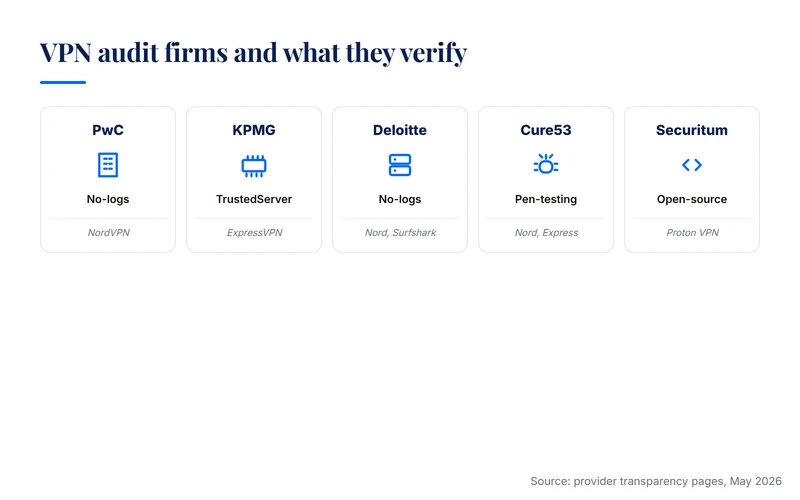
The strongest search signal for this comparison concerns audit evidence, so the scope matters more than a raw count. ExpressVPN publishes the broader library. Surfshark has current third-party assurance for its no-logs configuration and separate security assessments of its infrastructure and applications.
| Provider | Independent work | Scope | Assessment date |
|---|---|---|---|
| ExpressVPN | KPMG ISAE 3000 assurance | Privacy-policy claims and TrustedServer controls | February 28, 2025 |
| ExpressVPN | Cure53 and Praetorian security audits | Lightway protocol rewritten in Rust | September and October 2024, retested December 2024 |
| Surfshark | Deloitte ISAE 3000 assurance | No-logs configuration, systems, and internal processes | June 10, 2025 |
| Surfshark | SecuRing security assessments | Infrastructure, web, desktop, mobile apps, and browser extensions | 2025 |
What the ExpressVPN audits establish
KPMG examined ExpressVPN privacy controls and TrustedServer architecture as of February 28, 2025 under the ISAE 3000 Type 1 standard. The public report records no exceptions in the tested controls. That is useful evidence for the design and implementation present on the assessment date. It is not a promise about every future version or every event outside the stated scope.
ExpressVPN also commissioned Cure53 and Praetorian to review the Rust rewrite of Lightway in September and October 2024. The reports identified no critical findings, and the reported issues were addressed and retested in December 2024. This work concerns protocol implementation rather than the provider no-logs policy, so it answers a different security question.
What the Surfshark audits establish
Deloitte assessed whether Surfshark systems and internal processes supported its no-logs statement as of June 10, 2025. The work covered standard, static, and multiport VPN server types. This is the most relevant Surfshark evidence when comparing no-logs claims with ExpressVPN privacy assurance.
Surfshark also reports 2025 SecuRing assessments of network infrastructure and client applications. Those tests examine resistance to technical attacks and implementation weaknesses. They should not be presented as extra no-logs audits because the objective and evidence differ.
How to compare the evidence fairly
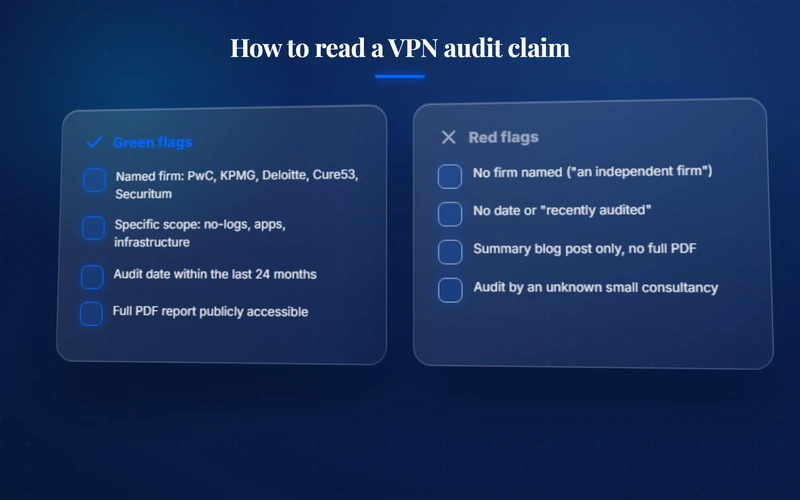
A no-logs assurance engagement checks whether defined systems and processes support a provider statement at a specified time. A protocol audit reviews code and cryptographic implementation. An infrastructure penetration test looks for exploitable weaknesses, while an application audit examines a particular client and version.
Audit verdict: ExpressVPN wins on breadth and public accessibility across server, protocol, app, extension, and router work. Surfshark still has relevant current evidence, including a 2025 Deloitte no-logs assurance report. The difference supports ExpressVPN for audit-focused buyers, but it does not erase Surfshark’s device-policy and value advantages. See our guide to VPN independent audits for the full evaluation framework.
Performance and protocol choice
ExpressVPN uses Lightway as its main modern protocol, while Surfshark supports WireGuard. Both are designed to reduce overhead compared with older configurations, but that does not create a fixed speed winner. Results change with server distance, congestion, device hardware, Wi-Fi conditions, internet provider, and the selected protocol.
An ExpressVPN vs Surfshark benchmark can show how each service behaved in one environment. It cannot predict every home connection. Test nearby locations and the routes you regularly use during the provider refund period. If a result looks poor, change the protocol, move to a less congested server, and compare over several times of day before deciding.
Device behavior matters as much as a headline throughput result. Sleep and wake recovery, network switching, battery use, and kill-switch behavior can differ across Windows, macOS, iOS, Android, and routers. Before committing, reproduce the tasks that matter to you: video calls, large downloads, online games, and switching between home Wi-Fi and mobile data. A service that reconnects reliably on your devices may be the better practical choice even if another provider leads one laboratory test.
Streaming and travel
For ExpressVPN vs Surfshark travel use, either VPN can encrypt traffic on hotel, airport, and cafe networks, which is useful when traveling. It does not guarantee access to a particular streaming catalog. Availability can change by service, server, account region, device, and date. The streaming provider terms and the rights attached to the subscriber account still apply.
ExpressVPN offers MediaStreamer for selected devices, while Surfshark provides Smart DNS instructions. Smart DNS does not provide the same traffic encryption as a VPN tunnel. Treat either feature as a compatibility option, not as a promise that every platform or catalog will work.
Privacy, ownership, and jurisdiction
ExpressVPN operates from the British Virgin Islands and is owned by Kape Technologies. Surfshark operates from the Netherlands and is part of the same company group as Nord Security. Jurisdiction and ownership are relevant, but neither should decide the comparison alone.
An ExpressVPN vs Surfshark privacy review also examines what account data is collected, how diagnostics are handled, whether activity and connection data are retained, how servers are administered, and whether public reports support the provider claims. ExpressVPN has the clearer advantage in audit breadth. Surfshark counters with a simple device policy that can reduce account sharing friction in a large household.
Account choices also affect the privacy outcome. Use a unique password, enable the available account protections, review optional diagnostic sharing, and keep the app updated. A VPN protects traffic between the device and VPN server, but it does not erase browser cookies, account logins, payment records, or information voluntarily shared with websites. The provider can reduce some network exposure; it cannot make every activity anonymous.
ExpressVPN vs Surfshark pricing and value
Promotional prices change too often for an undated table to remain reliable. Compare the same subscription length and note the full amount charged at checkout, not only the displayed monthly equivalent. Check taxes, included months, feature tier, renewal price, and whether an optional product has been added.
ExpressVPN now separates features across Basic, Advanced, and Pro tiers. Surfshark also sells different VPN and security bundles. Surfshark is the stronger value proposition for households that would otherwise need more connections, while ExpressVPN may justify its cost for readers who specifically want its router approach or broader audit library.
Both providers advertise refund periods, but eligibility can depend on the purchase channel and current terms. Read the policy before paying rather than assuming every purchase follows the same process.
For a fair value comparison, write down the number of people and active devices, then identify which paid extras are actually needed. A cheaper subscription can become less attractive if it excludes a required tool. A higher-priced tier can also waste money when its identity or security extras duplicate products already in use. Compare the VPN service first, then treat bundled tools as separate purchasing decisions.
How to use customer feedback
Store ratings, Trustpilot pages, forums, and support threads can reveal recurring issues with billing, renewals, device compatibility, or customer service. Their scores and review counts change continuously, and individual comments are not controlled tests.
Read recent positive and negative reviews, then filter for your operating system and country. Give more weight to repeated patterns than to one unusually enthusiastic or angry post. Customer feedback is supporting context, not proof of no-logs behavior, speed, or access to a specific online service.
Which VPN fits your setup?
Pick Surfshark if
You have many devices, share a subscription within a household, or place practical value above a long audit history. The unlimited simultaneous-connection policy is its clearest advantage. Confirm that the apps and optional features you need are included in the tier selected.
Pick ExpressVPN if
You prioritize a streamlined interface, dedicated router software, or access to a larger library of public audit reports. Check whether the Basic, Advanced, or Pro tier contains the connection limit and extra tools you expect. For deeper provider analysis, read our ExpressVPN review and Surfshark review.
Router coverage deserves separate consideration. A router connection can cover devices that cannot run a VPN app, but all traffic may share one location and troubleshooting is more involved. ExpressVPN provides a more integrated router path. Surfshark can work through manual configuration on compatible hardware. Check the router model, firmware instructions, and whether per-device location control is required before choosing on this feature.
Other comparisons to consider
NordVPN and Proton VPN may fit users whose priorities fall outside this matchup. NordVPN combines consumer features with repeated no-logs assurance engagements. Proton VPN emphasizes open-source applications and Secure Core routing, and our ExpressVPN vs Proton VPN comparison takes that pairing on its own terms. Compare the exact plans rather than assuming one ranking fits every buyer.
Our NordVPN vs ExpressVPN comparison examines another premium shortlist, while the NordVPN vs Surfshark comparison focuses more directly on features and household value.
FAQ
ExpressVPN vs Surfshark final verdict
Do not choose from a promotional monthly figure alone. Compare the total billed amount, renewal terms, selected tier, platform support, and current refund policy. For most buyers in this matchup, Surfshark offers the more practical balance. ExpressVPN remains a defensible choice when its specific strengths match the setup.
A sensible final check takes only a few minutes. Open both official plan pages in separate tabs, select the same billing length, and record the total due today plus the next renewal amount. Then confirm the device policy, router support, dedicated IP availability, and refund conditions for that exact tier. If the household has more than 14 active connections, Surfshark has the clearest structural advantage. If router management and audit documentation carry more weight than connection count, ExpressVPN deserves the closer look. This method produces a decision based on the actual setup rather than a temporary discount banner. Whichever way it goes, our Surfshark review and our ExpressVPN review hold the detail behind each column above.
Surfshark is the better recommendation for most value-focused households. Its unlimited simultaneous-connection policy is a concrete advantage when one account must cover many devices. ExpressVPN is the better fit for users who prioritize dedicated router software, a streamlined product approach, and a broader public audit record.
